01
Perturbation-derived RL
Gene, pathway, and format rewards stay tied to perturbation observations rather than free-form preference signals.
Perturbation-derived reinforcement learning
PertMind turns measured gene responses into computable reward signals. Instead of depending on manually curated reasoning traces, it uses perturbation observations to shape structured biological reasoning at scale.
Core discovery
Measured terminal outcomes can supervise learning without pretending to reveal every hidden mechanism.
PertMind operationalizes cellular perturbation observations as
cell line, perturbation, target gene queries with experimentally observed
responses. These endpoints provide scalable reward signals for learning structured
biological outputs.
The claim boundary is explicit: correct perturbation endpoints do not by themselves prove that every generated intermediate explanation is causally faithful. The model's reasoning remains a hypothesis-bearing scaffold for research, not a proof of complete biological mechanism.
01
Gene, pathway, and format rewards stay tied to perturbation observations rather than free-form preference signals.
02
“Emergent” here means usable capability on a task that was absent from post-training, not a claim of omniscience.
03
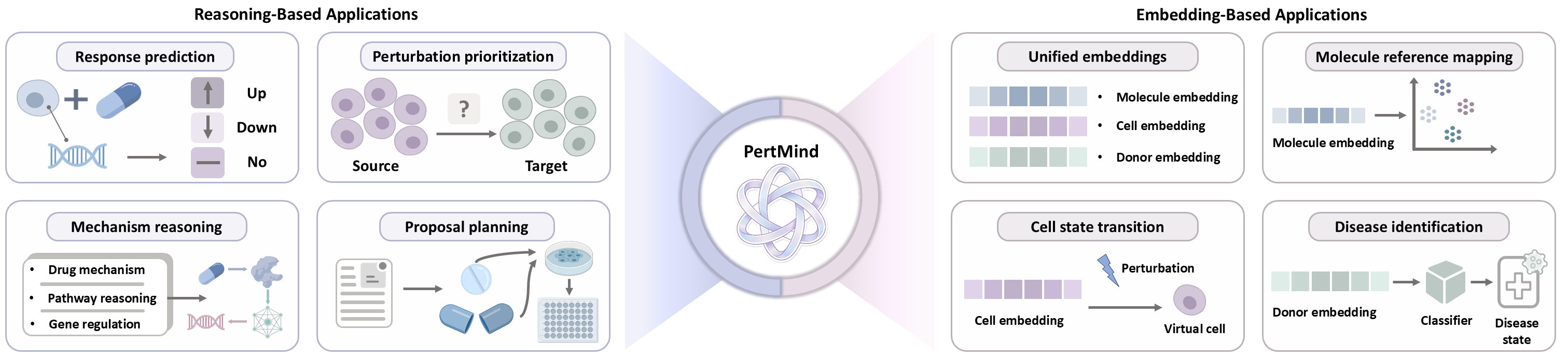
PertMind-generated profiles can support downstream molecular, cellular, and donor representations alongside reasoning tasks.
Capability overview
How it works
01
Organize cellular perturbation observations into cell-line, perturbation, and target-gene prompts with measurable response labels.
02
Use supervised fine-tuning on trusted structured outputs so the model starts from a legible reasoning format.
03
Run GRPO over gene outcomes, pathway directions, and output format consistency, all tied back to perturbation evidence.
Evidence and boundaries
“Emergent” is used operationally: a capability counts as emergent when it appears on a task absent from post-training.
Generated reasoning should be read as a hypothesis-bearing explanation that helps users inspect possible biological logic. It is not proof of a complete causal mechanism, and Figure 1 should not be read as a benchmark summary for every depicted use case.
Model access
Released under the Apache-2.0 License for research-oriented public use.
git clone https://github.com/shapsider/PertMind
cd PertMind
conda create -n pertmind python=3.11 -y
conda activate pertmind
git lfs install
git clone https://huggingface.co/tzcfly/PertMind model-release
cd model-release
pip install -r requirements.txt
python inference_vllm.py \
--model . \
--prompt "In HCT116, predict how LMBR1 changes expression of SLC26A6."