

NeurIPS 2026Balanced Fine-Tuning

Aligning LLMs with
Biomedical Knowledge
using Balanced
Fine-Tuning

Preserving the learning signal in difficult biomedical contexts.

A dual-scale post-training objective guided by local confidence, designed for knowledge-dense biomedical text.

Zhenchao Tang*1, Fang Wang*†1, Haohuai He1, Jiale Zhou1, Tianxu Lv1, Jun Zhu1, Shouzhi Chen1, Minghao Yang1, Yu Wang1, Jiayang Wu1, Yidong Song2, Yaokun Li3, Jiehui Huang4, Jun Zhou5, Bing He1, Jianhua Yao†1

1Tencent AI for Life Sciences Lab   2Nankai University   3Sun Yat-sen University
4The Hong Kong University of Science and Technology   5Tsinghua University

* Equal contribution   † Corresponding authors

TencentTencent AI for Life Sciences Lab

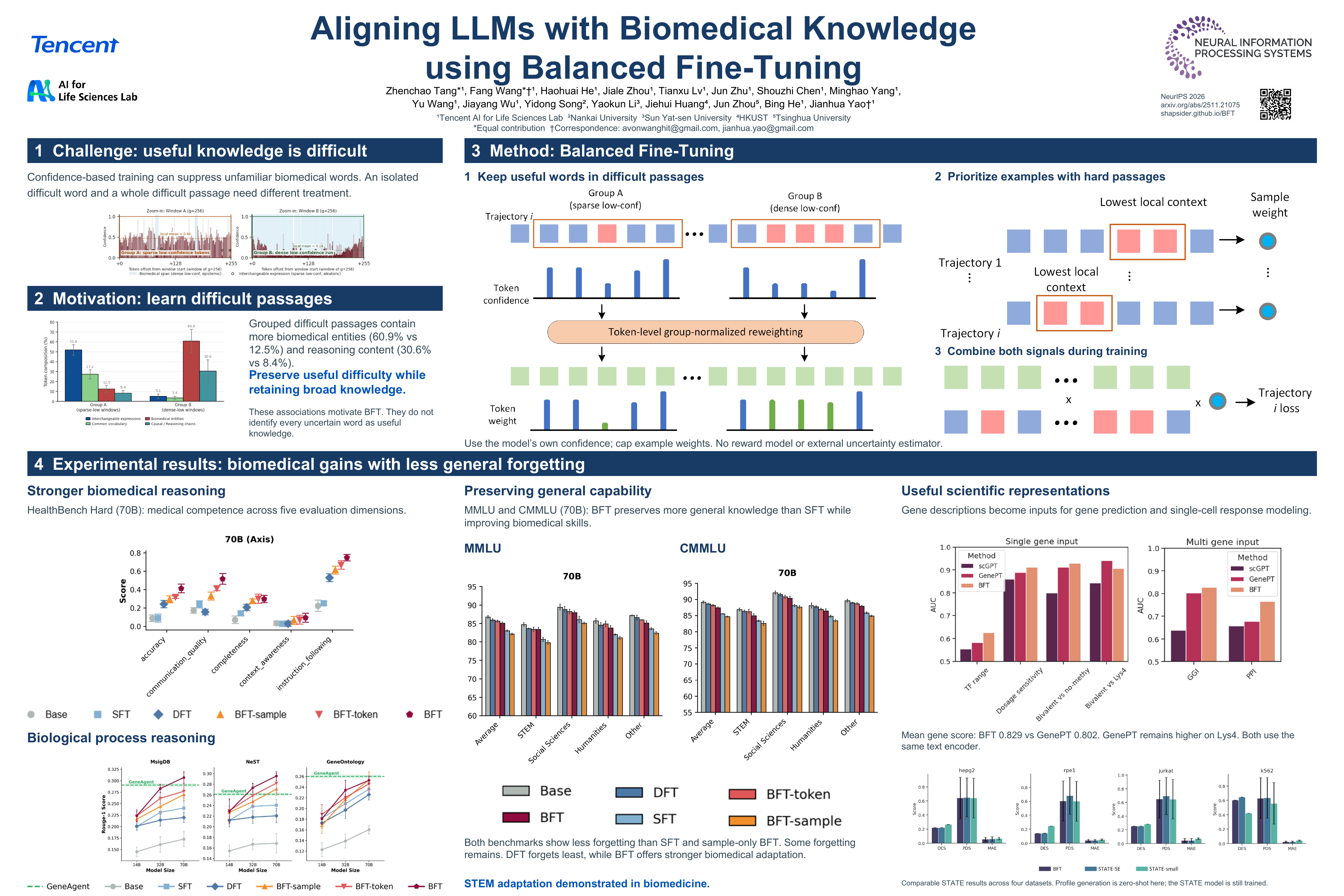
Low confidence has a local structure.

In biomedical text, contiguous runs of low-confidence tokens often contain rare entities and mechanistic steps. Treating every uncertain token alike can suppress the knowledge we want the model to learn.

BFT compares each token’s confidence with its surrounding context and gives more weight to sequences containing difficult regions. The two signals allocate learning effort within and across sequences.

60.9%

Biomedical entities among low-confidence tokens in dense PMC windows, versus 12.5% in sparse windows.

+13.4pp

VCWorld accuracy over SFT for the aligned 70B backbone under a shared recipe.

+4.0pp

VCWorld improvement after subsequent GRPO, from 0.696 to 0.736.

Source: paper Introduction, VCWorld results, and Appendix diagnostic. Concept enrichment supports an interpretation of knowledge gaps; it is not direct ground truth for epistemic uncertainty.
One window. Two scales.

BFT uses a centered local window of valid target tokens, with a default size of g = 256. Prompt and padding positions do not contribute to the loss. Confidence-derived weights use stop-gradient.

Figure 1. Biomedical uncertainty structure and the BFT objective. Click any figure to enlarge.

Within a sequence

ρb,t = clip(cb,t / (Cb,tloc + ε), 0, 1)

Compare token confidence with the local mean. A difficult token retains more signal when its entire context is difficult.

Across sequences

sb = sg(1 − mint Cb,tloc)

Use the weakest local region to assign a bounded sample weight. Sequences with difficult regions receive greater relative emphasis.

Combined objective
LBFT = (1/B) ∑b sb [∑t mb,t sg(ρb,t) ℓb,t] / [∑t mb,t + ε]
Explore the token weight

Same token. Different context.

Fix the target-token confidence at c = 0.10 and vary the local mean. This illustrates the token weight before sample-level scaling.

Difficult contextConfident context
SFT
1.000
DFT
0.100
BFT token
0.500

Biomedical reasoning and RL compatibility.

We independently fine-tune DeepSeek-R1-Distill backbones at 14B, 32B, and 70B using a shared optimization recipe. The medical and biological mixture contains 51,056 filtered samples, with 48,503 in the supervised training split.

Chemical perturbation reasoning

VCWorld · 70B · five held-out cell lines
Average Up / Down / No classification accuracy
InitializationBefore GRPOAfter GRPOChange
DFT0.4900.420−0.070
SFT0.5620.486−0.076
BFT-sample0.5960.624+0.028
BFT-token0.6600.694+0.034
BFT0.6960.736+0.040

Three-decimal averages from the Results section. The paper’s main table rounds these to two decimals. Changes here use the displayed three-decimal values.

Before GRPO, BFT is numerically higher than the Gemini-2.5-Flash backbone (+0.018), but the difference is not statistically significant across five cell-line means (95% CI [−0.004, 0.040], p = 0.088). Reported inference variability and training-seed variability are separate. The RL pattern applies to the evaluated VCWorld setup.

Figure 2. Medical competence on HealthBench Hard and biological process reasoning with GeneAgent. BFT improves more consistently than the supervised baselines under the shared recipe.
General capability retention and window sensitivity
Figure 3. DFT forgets least, followed by BFT-token and BFT. The window-size study uses the 14B model and is not directly comparable to 70B VCWorld results. The injected-preference test covers one preference and is not a general safety evaluation.

Better profiles support biological representations.

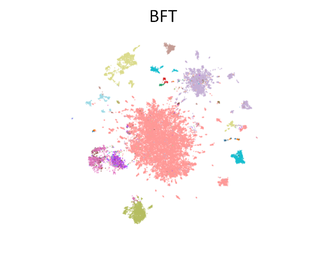
BFT-70B generates biomedical entity profiles. Encoding those profiles with text-embedding-ada-002 yields gene representations, which also support expression-weighted cell embeddings.

Figure 4. BFT gives the best average gene-level performance and improves the evaluated cell-clustering tasks. GenePT remains higher on Lys4.
Figure 5. With the STATE decoder retained, BFT embeddings perform comparably to standard inputs across four perturbation datasets. Profile generation is zero-shot with respect to these datasets; decoder training is not.

For multimodal integration, BFT reaches 0.57 overall scIB, above Harmony and BBKNN but below paired-supervision scMODAL (0.65). Improvements are task-specific and do not establish a general factuality or deployment guarantee.

Resources

Quick start

Enable BFT in your LLaMA-Factory training configuration. See the repository for setup and the complete recipe.

stage: sft
do_train: true
use_bft_loss: true
# Default local confidence window: BFT_GROUP_SIZE=256

BibTeX

@article{tang2025aligning,
  title={Aligning LLMs with Biomedical Knowledge using Balanced Fine-Tuning},
  author={Tang, Zhenchao and Wang, Fang and He, Haohuai and Zhou, Jiale and
          Lv, Tianxu and Zhu, Jun and Chen, Shouzhi and Yang, Minghao and
          Wang, Yu and Wu, Jiayang and Song, Yidong and Li, Yaokun and
          Huang, Jiehui and Zhou, Jun and He, Bing and Yao, Jianhua},
  journal={arXiv preprint arXiv:2511.21075},
  year={2025},
  note={Accepted at NeurIPS 2026},
  doi={10.48550/arXiv.2511.21075},
  url={https://arxiv.org/abs/2511.21075}
}

Correspondence: Fang Wang and Jianhua Yao.